 by Admin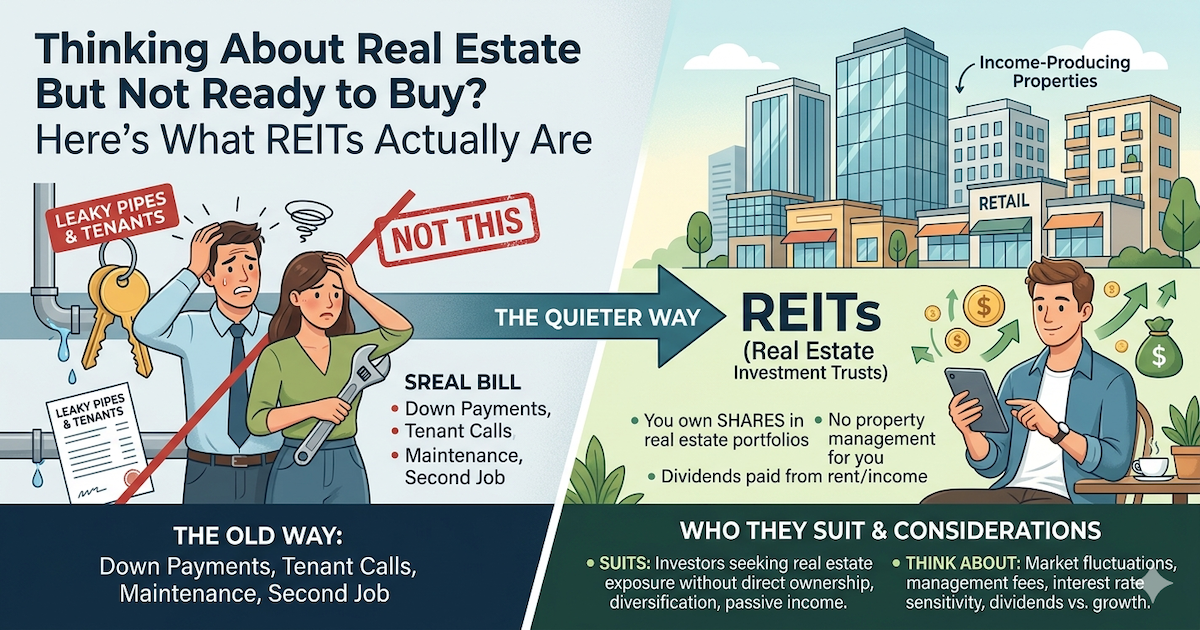
Most people picture real estate investing and immediately think of down payments, leaky pipes, and tenants calling at midnight. It sounds like a second job — because honestly, it kind of is.
But there’s a quieter way to get into real estate that doesn’t involve owning a single brick. It’s called a REIT, and if you’ve never heard of it, you’re not alone.
This isn’t a pitch. It’s just a plain explanation of what REITs are, who they tend to suit, and what to think about before you put any money in.
So what actually is a REIT?
REIT stands for real estate investment trust. In plain terms, it’s a company that owns income-producing real estate — things like apartment buildings, warehouses, hospitals, data centers, or shopping centers.
When you buy shares in a REIT, you’re buying a small slice of that portfolio. You don’t manage anything. You don’t fix anything. You just own a piece of the business, and if the business does well, you may receive a share of the income it generates.
By law, REITs are required to distribute at least 90% of their taxable income to shareholders. That’s why many people associate them with regular dividends — though the amount varies and nothing is guaranteed.
How is this different from just buying a property?
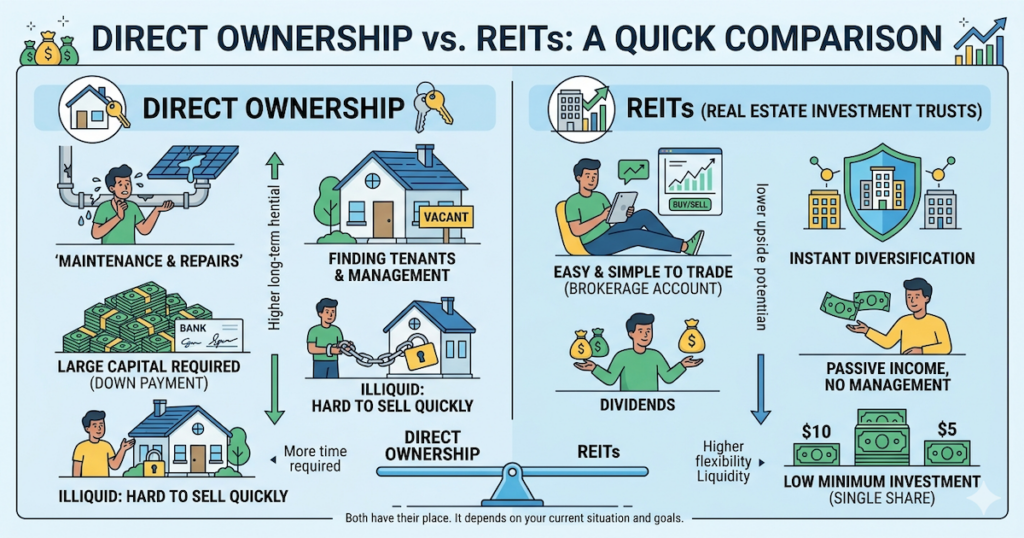
Owning a property outright gives you more control, but also more exposure. You’re responsible for the mortgage, the maintenance, the insurance, finding tenants, and everything that goes sideways in between.
REITs work differently. You can buy and sell shares through a standard brokerage account, often with no minimum beyond the price of a single share. That’s a meaningful difference if you’re still renting, still saving, or just not ready to commit to a physical asset.
Direct property ownership can offer more upside over time, especially with leverage and the right market. But it also requires more capital, more patience, and more hands-on involvement. REITs trade some of that upside for simplicity and flexibility — which isn’t a bad deal depending on where you are right now.
Does this mean you should skip buying a home?
Not necessarily. REITs and property ownership aren’t really competing with each other. They serve different purposes.
If you’re a first-time buyer saving for a deposit, a REIT won’t replace that goal. But it might give you some exposure to real estate markets while you wait — and teach you something about how those markets behave along the way.
If you’re a renter who isn’t sure homeownership is the right move yet, REITs let you participate in real estate without making that commitment.
And if you’re already a property investor, REITs can add a different type of real estate exposure to what you already own — without taking on another mortgage.
Starting with a small amount
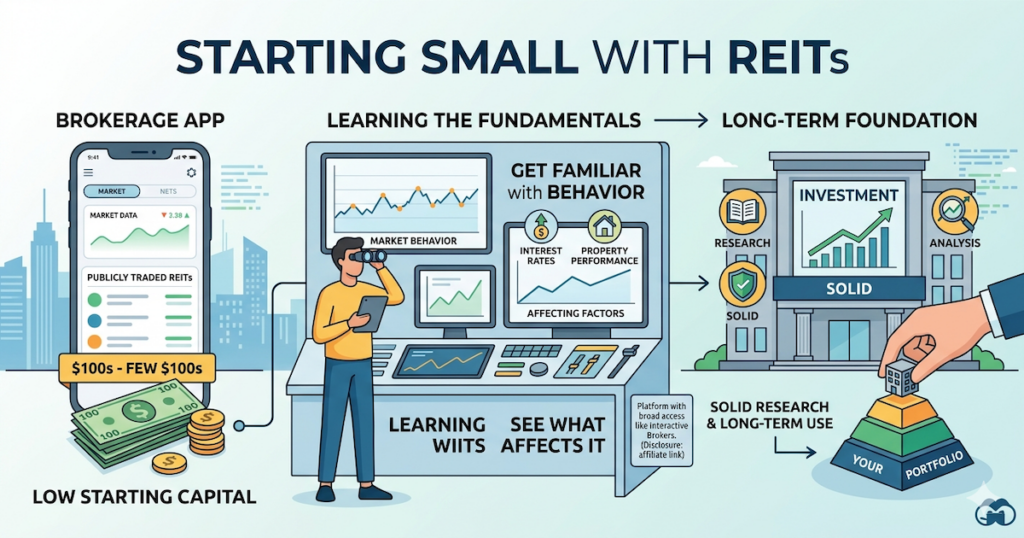
One of the more practical things about REITs is that you don’t need much to begin. A few hundred dollars can get you started on a platform that gives you access to publicly traded REITs or REIT-focused funds.
The goal at that stage isn’t to make a lot of money quickly. It’s to get familiar with how the investment behaves — how it moves, what affects it, and whether it fits how you think about money.
For a platform with broad investing access that many serious investors use, I’d point you toward Interactive Brokers. It’s not the flashiest interface, but it’s solid for research and long-term use. (Disclosure: this is an affiliate link — I may earn a small commission if you sign up, at no cost to you.)
A few things worth knowing before you invest
REITs aren’t all the same. Some focus on residential housing, others on industrial or logistics properties, healthcare facilities, or digital infrastructure. What a REIT owns matters — and so does how it’s been performing and whether its sector still makes sense in the current economy.
They also go up and down. REITs can be affected by interest rates, vacancy rates, economic conditions, and the specific sectors they’re tied to. They’re simpler than direct ownership in a lot of ways, but they’re still investments — not savings accounts.
The approach that tends to hold up best for beginners is straightforward: invest an amount you can afford to leave alone, focus on understanding what you own, and don’t expect quick results.
A reasonable place to start
If you’ve been curious about real estate but felt like the entry cost was too high, REITs are worth understanding. They won’t give you everything that direct ownership does, but they can give you real estate exposure with less money, less complexity, and a lot less stress.
Start by reading about what different REITs own. Compare a few. Look at how they’ve performed over different periods. Use a platform that makes it easy to do that research without overwhelming you.
And if you want somewhere to start exploring, Interactive Brokers is worth a look. Just invest at your own pace — there’s no version of this that needs to be rushed.