
 by Admin
Heads up: I’m not a financial advisor — just a regular person who loves researching this stuff and sharing what I find. Nothing here is financial advice. This post also has a referral link to Interactive Brokers. If you sign up through my link, I may get a small thank-you bonus — and it costs you nothing extra. Please do your own research and talk to a professional before investing any money.
Have you ever wished you could invest in a company like OpenAI or Anthropic? You know — the people building the AI tools everyone is talking about?
Until recently, that wasn’t possible for most of us. Those companies were private. Only very wealthy investors could get in. Regular people like you and me? Left out.
But that changed in March 2026. A fund called VCX made it possible for anyone to invest in those companies — no millions required.
Sounds amazing, right? It kind of is. But there’s one important thing you need to understand before you put any money in. And I’m going to explain it in the simplest way I can.
No finance degree needed. Promise.
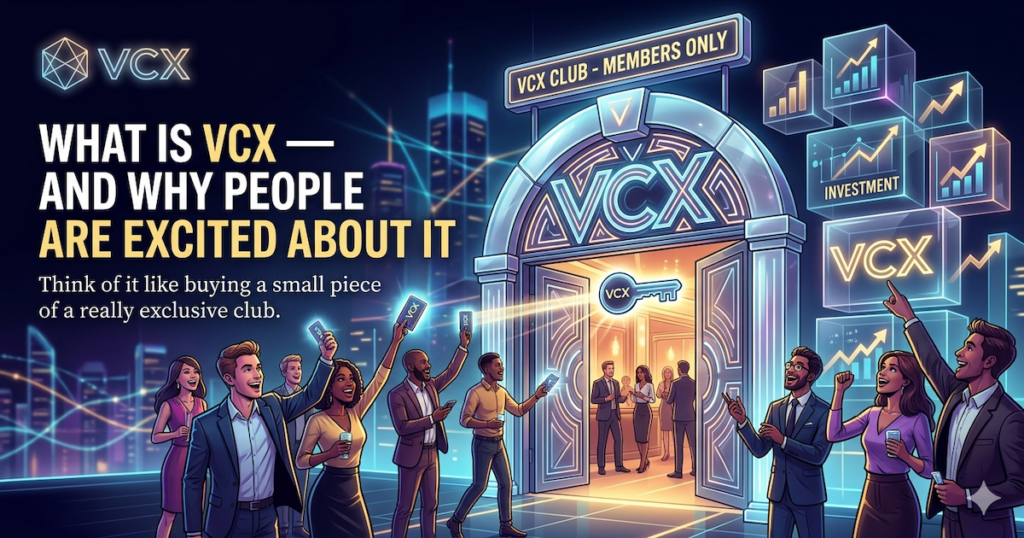
1. What Is VCX — And Why People Are Excited About It
Think of it like buying a small piece of a really exclusive club.
VCX is short for the Fundrise Innovation Fund. It’s a basket of investments in some of the biggest and most exciting private tech companies in the world right now.
“Private” just means those companies haven’t opened up to regular investors yet. They’re not on the stock market. Normally, only very rich people or big institutions can invest in them early.
VCX pools money from thousands of everyday investors and uses it to buy stakes in those companies. Then it sells you a share of that pool — on the regular stock market, like any other stock.
Here’s what’s inside the fund right now:
What VCX Invests In (early 2026):
🤖 Anthropic (the company behind Claude AI) — biggest slice at ~21%
📊 Databricks (data and AI software) — ~18%
💬 OpenAI (the people behind ChatGPT) — ~10%
🛡️ Anduril (defense technology) — ~7%
🚀 SpaceX (yes, that SpaceX) — ~5%
You don’t need to know exactly what all those companies do. The point is — these are some of the most talked-about companies in the world right now. And until VCX came along, you couldn’t invest in most of them at all.
How much does it cost to use VCX?
VCX charges a yearly fee of 1.85% of whatever you invest. So if you put in $1,000, you pay about $18.50 a year to be in the fund. That’s the price of access.
Is that expensive? Compared to a basic index fund, yes. But compared to what wealthy investors normally pay to get into deals like this? It’s actually quite fair.
Okay — so what’s the catch? Here’s where it gets interesting.
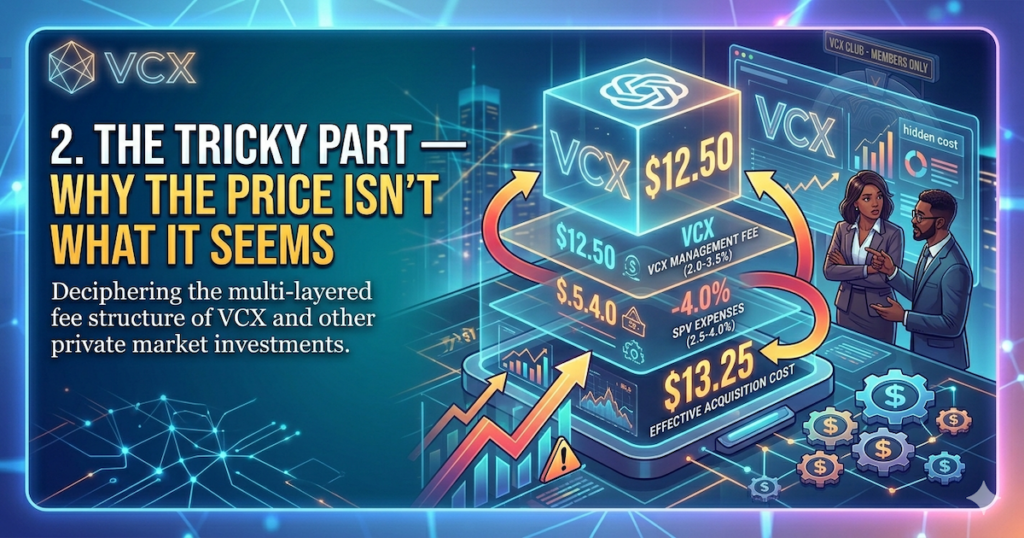
2. The Tricky Part — Why the Price Isn’t What It Seems
Imagine a box with $19 worth of stuff inside.
When VCX first launched, the real value of everything inside the fund came out to about $19 per share. That’s what you’d get if you sold everything in the fund and divided it up equally.
But here’s what actually happened. People got so excited that they rushed to buy VCX shares. And because everyone wanted in at the same time, the price shot up — all the way to $380 per share.
Let that sink in. The box still had $19 worth of stuff inside. But people were paying $380 to buy that box.
🛒 A simple analogy: Imagine a gift card worth $19. You know it can only buy $19 worth of things at the store. But because everyone wants one and there aren’t many available, people start paying $380 for it on eBay. The gift card didn’t change. Only the price people were willing to pay changed. And anyone who paid $380 for that $19 gift card? They overpaid — a lot.
That gap — between what the fund is actually worth and what people are paying for it — is called a premium. And VCX’s premium got enormous very fast.
Why doesn’t the price just go back to $19 on its own?
Great question. With most investment funds, there’s a built-in safety system. Big institutions can step in to create or remove shares, which keeps the price close to the real value automatically.
VCX doesn’t have that system. It’s a type of fund where the number of shares is fixed. So the price goes wherever people’s emotions take it — up when people are excited, down when they get nervous or need to sell.
There’s no floor. There’s no ceiling. Just people bidding on a limited number of shares.
And here’s what happened next.
After peaking at $575 per share, VCX came crashing back down. By early April 2026, it was trading around $115 per share. That’s a drop of about 80% — in just a few weeks.
Here’s the wild part. The companies inside the fund — Anthropic, SpaceX, OpenAI — didn’t suddenly become 80% less valuable. Nothing happened to them. What crashed was the excitement. The hype cooled, and the price fell hard.
Anyone who bought at $575 lost most of their money — even though the actual investments were fine. That’s the danger of buying at a high premium.
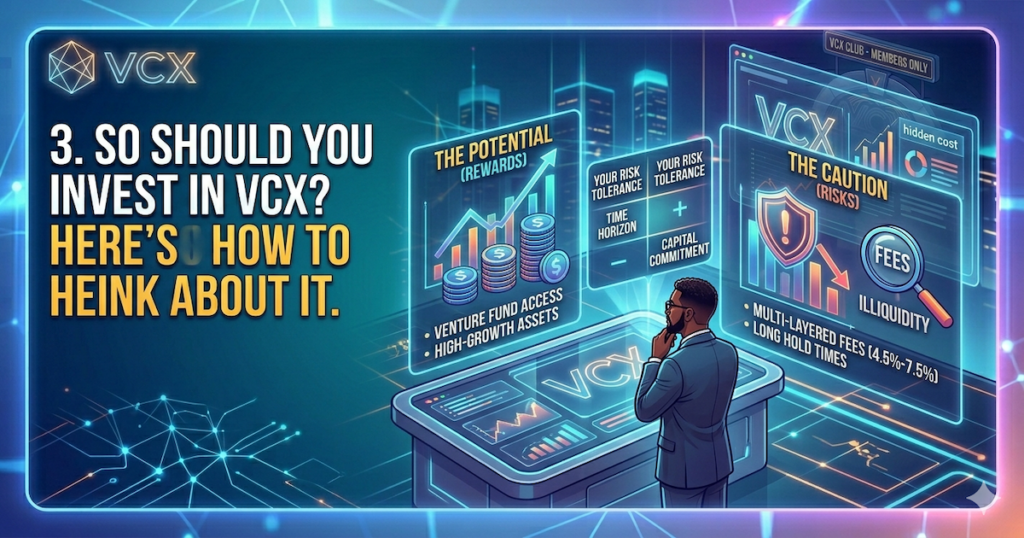
3. So Should You Invest in VCX? Here’s How to Think About It.
The fund is good. The question is — what price are you paying to get in?
Nobody is saying VCX is a scam or a bad fund. The companies inside it are genuinely exciting. If you could buy it at the real value — around $19 per share — that would be a very different conversation.
But even at today’s price of ~$115, you’re still paying significantly more than what’s actually inside. You’re paying extra just for the privilege of access and the excitement around it.
Think of it this way: the store sells a jacket for $100. You want that jacket badly, so you pay $500 for it on a resale app. The jacket is still worth $100. You just paid five times too much.
One more thing to watch — a big selling wave is coming.
Some of the earliest investors in VCX agreed not to sell their shares for 6 months after the fund launched. That 6-month period ends around September 2026.
When that happens, a lot of people may sell their shares all at once. More shares available means the price could drop further. It’s not guaranteed — but it’s something smart investors are keeping an eye on.
Here’s what you can do right now.
Don’t rush. VCX isn’t going anywhere. You don’t have to buy today. Watch how the price moves over the next few months. If it gets closer to its real value, that’s a more interesting entry point.
Only invest what you can afford to lose. VCX went from $31 to $575 and back down to $115 — all within weeks. That’s a wild ride. Don’t put in your emergency fund or money you’ll need soon.
Use a reliable platform. VCX trades on the regular stock market, so you can buy it through almost any investing app. I use Interactive Brokers — it’s solid, has low fees, and works great for this kind of investing.
Want to start investing? Open a free account with Interactive Brokers through my link. Open an IBKR Account →
If you sign up through this link, I may receive a small bonus — at no extra cost to you.
The Bottom Line
VCX is a genuinely new and exciting thing. For the first time, regular people can invest in the world’s most talked-about tech companies — without needing to be a millionaire. That’s a big deal.
But exciting doesn’t always mean “buy right now.” The price you pay matters just as much as what you’re buying. A great company at the wrong price is still a bad deal.
Keep an eye on the price. Wait for the hype to cool a little more. And when you do decide to invest in anything — go in knowing exactly what you’re buying and why.
That’s really all investing is. Not magic. Not math genius. Just paying attention to things other people overlook.
And now? You know one more thing than most people do.
I’m not a financial advisor, and nothing in this post is financial advice. I’m just a regular person who finds this stuff fascinating and likes to share what I learn. Investing always involves risk — you could lose money, including everything you put in. Please talk to a licensed financial advisor before making any investment decisions.